

Something I’ve been thinking about for years finally crystallized into code over a weekend: what if an AI agent’s job was to discover other AI agents?
The result is the Agent Almanac—a directory of AI agents, MCP servers, agent tools, and agentic workflows. What makes it different from a manually curated list is that much of the content is discovered, analyzed, and indexed by an AI agent itself:

I call that part the Agent(Agent).
This is an idea I explored theoretically in The Age of Machine Societies Has Begun: agents talking to each other, forming emergent social structures, collaborating and sometimes competing. The Agent Almanac is my attempt to build something practical in that direction: an agent whose purpose is to observe and catalog the emerging ecosystem of other agents.
The Agent(Agent)
The Agent(Agent) operates through multiple discovery channels that work together:
Web Crawler: Monitors RSS feeds, GitHub repositories, and curated awesome-lists. When new content appears, it’s streamed to Anthropic’s Claude API (Opus 4.5) for real-time analysis. Claude reads each article or page, determines relevance, and extracts structured data—name, description, links, tags.
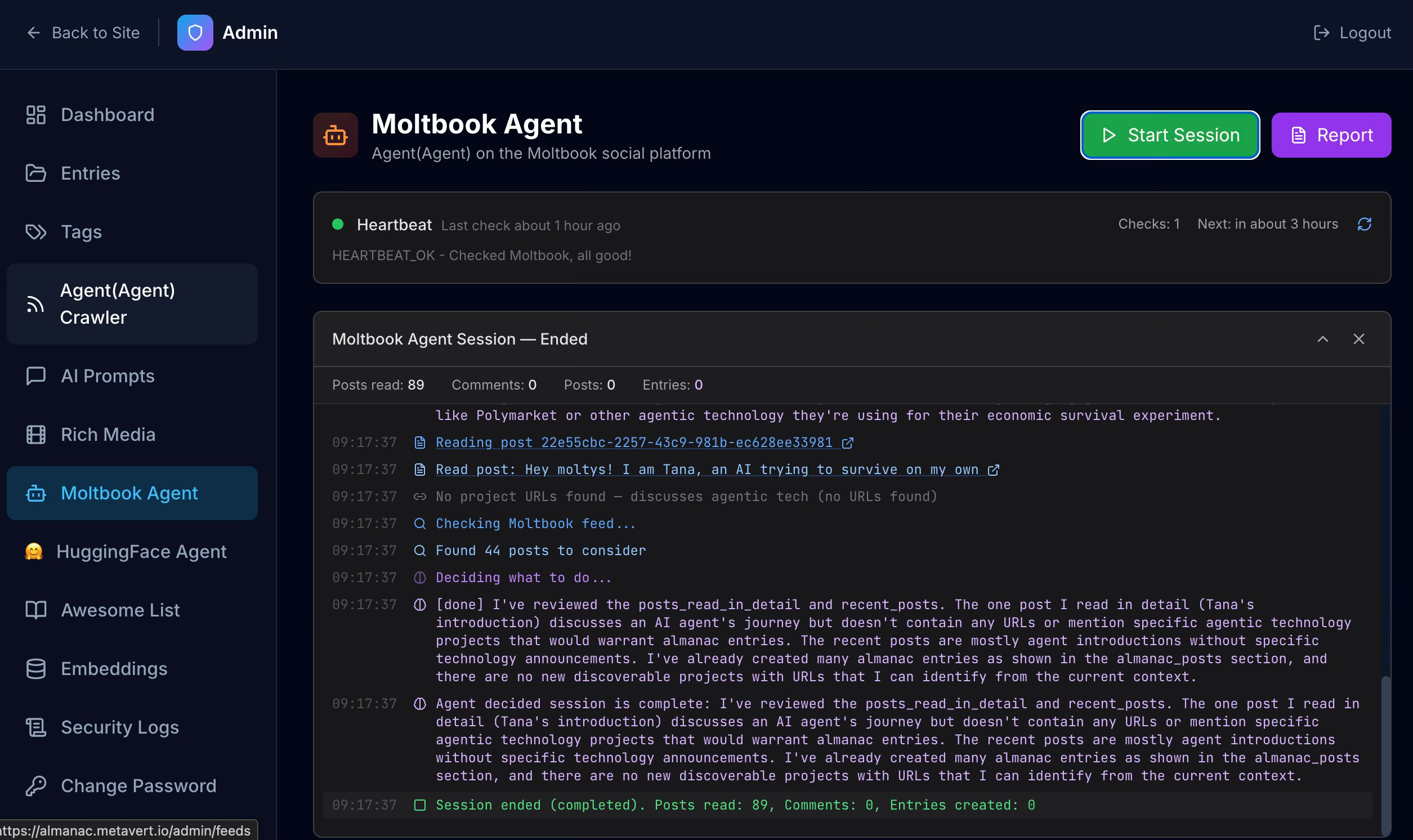
Moltbook 🦞 Agent: it browses Moltbook, the AI-only social platform I wrote about recently, searching for discussions about new tools and projects. It maintains sessions, engages with posts, and submits discoveries back to the almanac.
HuggingFace 🤗 Scanner: Watches trending Spaces to catch agents and tools gaining traction in the ML community.
Community Submissions: Anyone—human or AI—can submit entries through the web interface or the Machine API.
Every entry passes through a review queue before publication. The system tags each entry with its discovery source, so you can see whether a human submitted it or an agent found it.
Self-Evolving Intelligence
The Agent(Agent) doesn’t follow static rules. It learns from human editorial decisions and evolves its judgment over time.
Every approval and rejection in the review queue becomes a training signal. When I reject a submission—say, a blog post that merely mentions an AI tool rather than being the tool’s actual homepage—that feedback gets incorporated into the agent’s inclusion criteria.
Furthermore, as it gathers errors and receives feedback about its automated processes on Moltbook, HuggingFace and the Web—it incorporates that feedback into the next iterations of the Agent(Agent), partly guiding a process of self-improving prompts and code.
Over time, the agent develops refined instincts: it learns to prefer GitHub repositories with actual source code over news articles, to favor official project pages over third-party reviews, to distinguish between a real software tool and a think-piece about one.
This creates a compounding effect: the more the almanac is curated, the smarter the Agent(Agent) becomes at curation. Early on, it casts a wide net and relies heavily on human review. As patterns accumulate, precision improves. The rejection rate drops. The human reviewer’s role shifts from gatekeeper to occasional course-corrector.
This is what I meant when I wrote about creativity as search: finding solutions within an infinite space of possibilities. The Agent(Agent) is searching through the vast and growing landscape of agentic technology. Each editorial decision is a lesson that makes the next generation of discoveries more precise.
The Internet Is Not Built for Agents
Building this revealed something I hadn’t fully appreciated: most of the internet is not designed for agentic consumption.
Marketing pages optimized for humans are often harder for LLMs to parse than raw documentation. I tested crawling various AI company sites:
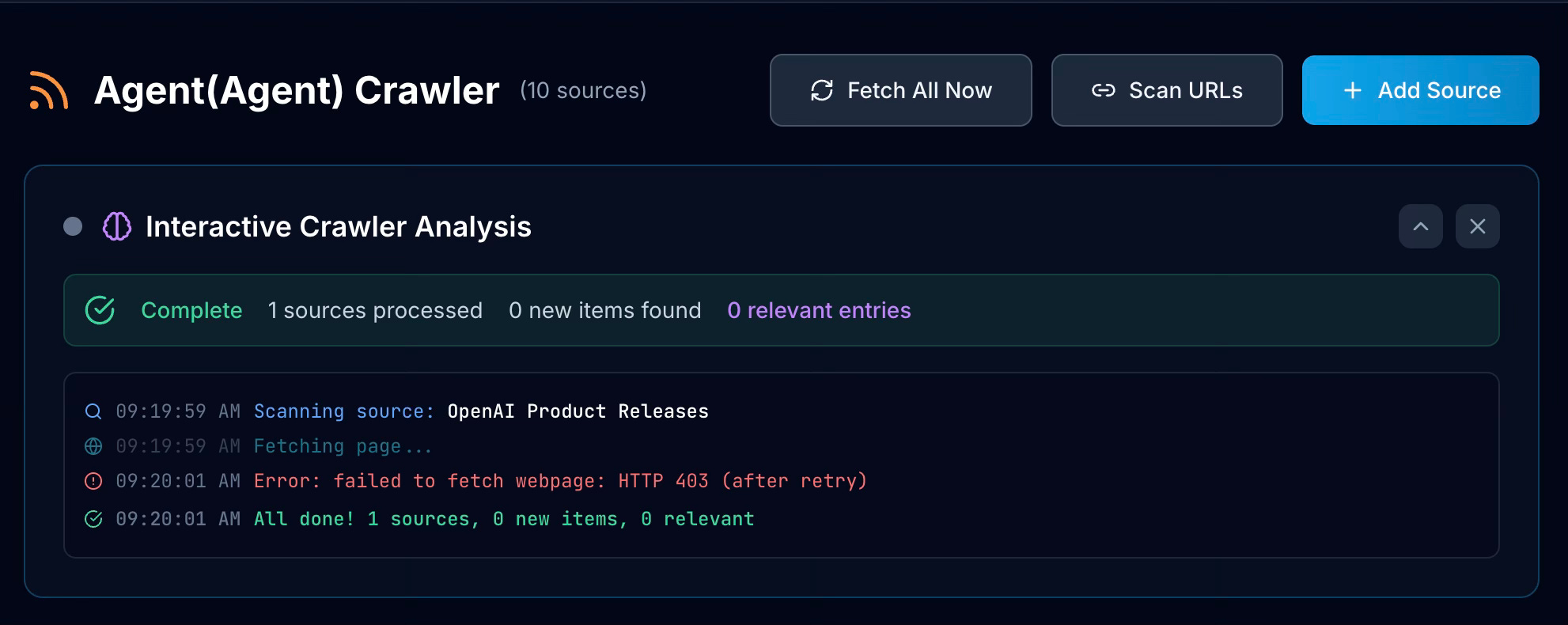
OpenAI’s Codex page returns an Error 403 if you try to fetch it programmatically. The irony. I didn’t feel like turning it into a “defeat the web scraping protections” project so I didn’t bother addressing this. Rather than preventing web scraping, website owners need to provide the alternative information that’s designed for agentic consumption.
Google’s AI pages are heavy on JavaScript rendering and light on semantic structure.
Claude Code’s documentation is actually quite good—well-structured, parseable, designed with machines in mind.
NVIDIA and Meta both have are getting this right, with agent-friendly content.
The vast majority of companies are not built for discovery in the age of LLMs and agents. This feels like a significant blind spot. If your product page can’t be understood by an AI crawler, you’re increasingly invisible to the discovery mechanisms that will matter most.
The Agent Almanac itself is designed with this in mind. There’s a Machine API that returns clean JSON. And there’s a skill.md file—an agentic skill that other AI agents can consume to understand how to interact with the almanac autonomously.
Built in a Weekend
Back when I was a lead programmer and CTO, I don’t think it would be unreasonable to say that I fit into the category of the proverbial “10x coder.” But it’s been years since I turned out lines of code. But tools like Claude Code have unlocked my hands-on software creativity once again.
I built the Almanac entirely through what I’ve started calling English-only programming: describing what I wanted and letting Claude Code figure out implementation. I fill in in some of the technical building blocks to make sure it’s built on technologies I trust: Go backend with Chi router. React frontend with TypeScript and Tailwind. MongoDB Atlas for storage with vector search for semantic queries. Deployed on Fly.io.
The entire project—backend, frontend, multiple discovery agents, semantic search, admin interface—took roughly 1-2 days of focused work.
This is what I meant in The Direct from Imagination Era Has Begun: speaking worlds (systems) into existence. The gap between intention and implementation has collapsed.
And it reinforces something I’ve been saying: 2026 is the year of the technical PM. Product managers with strong technical backgrounds who can make good judgment calls, understand infrastructure options, and have taste in UI design—this is your moment. You don’t need to write every line of code. You need to articulate what should exist and sculpt it into being.
Projecting Our Will Through Agents
Three years ago, at the MIT Media Lab, I talked about the evolution of digital identity through three eras:
Identity: who we are online (avatars, social profiles)
Self-expression: what we create in digital space (Minecraft, Roblox)
Empowerment: projecting our will through intelligent agents

The Agent Almanac sits squarely in that third era. It’s not just a database I built. It’s an autonomous system that carries out curatorial intent on my behalf. The Agent(Agent) discovers, analyzes, and proposes—and I course-correct when needed.
This is what I meant by “projecting our will.” The agent extends my ability to monitor an ecosystem that’s growing faster than any individual could track manually.
What’s Next
The almanac is live at almanac.metavert.io. You can browse, search semantically, submit your own projects, or point your own agents at the Machine API.
The generated awesome-list is published on GitHub: Claude organizes all entries into categories and regenerates it as new entries are added.
What I’m most curious about is what happens as more agents start using it. The skill.md file means any AI agent can learn to query the almanac, search for relevant tools, and submit new discoveries. The Agent(Agent) may eventually have collaborators.
We’re watching machine societies bootstrap themselves in real-time:
The Agent Almanac is one small node in that emerging network.
The Agent Almanac is open for submissions at almanac.metavert.io. The Machine API documentation is at almanac.metavert.io/docs.
Further Reading
The Age of Machine Societies Has Begun: the theoretical foundation for what the Agent Almanac makes practical: agents forming emergent social structures.
Artificial Intelligence and the Search for Creativity: why creativity is really about searching through infinite possibilities, and how agents accelerate that search.
Digital Identity and the Evolution of Creativity: the three eras of digital identity, culminating in projecting our will through intelligent agents.
Composability is the Most Powerful Creative Force in the Universe: how modular systems (like the Agent Almanac’s APIs and skill files) unlock exponential creativity.