

Two years ago, launching a SaaS business required a founding team: a backend engineer to build authentication and billing, a frontend developer for the dashboard, a DevOps person to handle deployment, and three to six months before you could write a single line of the business logic that actually mattered. The infrastructure alone, the commodity plumbing every SaaS needs, consumed far too much of your budget and all of your patience.
That era is over.
AI agents have collapsed the gap between a founder’s vision and production software. I’ve been building at this intersection: shipping real products through conversations with AI coding agents, writing about what I’ve called the shift from the Engineering Era to the Creator Era—and I reached a point where the biggest remaining friction wasn’t the AI. It was the starting point. Every new SaaS project still required rebuilding the same foundational infrastructure from scratch, or paying hundreds of dollars for a boilerplate that was missing half of what a production product actually needs.
So I built LastSaaS. It’s a complete, production-ready SaaS foundation: authentication, billing, multi-tenancy, white-labeling, webhooks, admin dashboards, health monitoring — built on a modern Go and React stack, designed from the ground up to be extended by you and your AI agents. It’s free. MIT licensed. No catch.
I want to tell you what it does, how it works, and why I think it represents something much larger than a boilerplate.
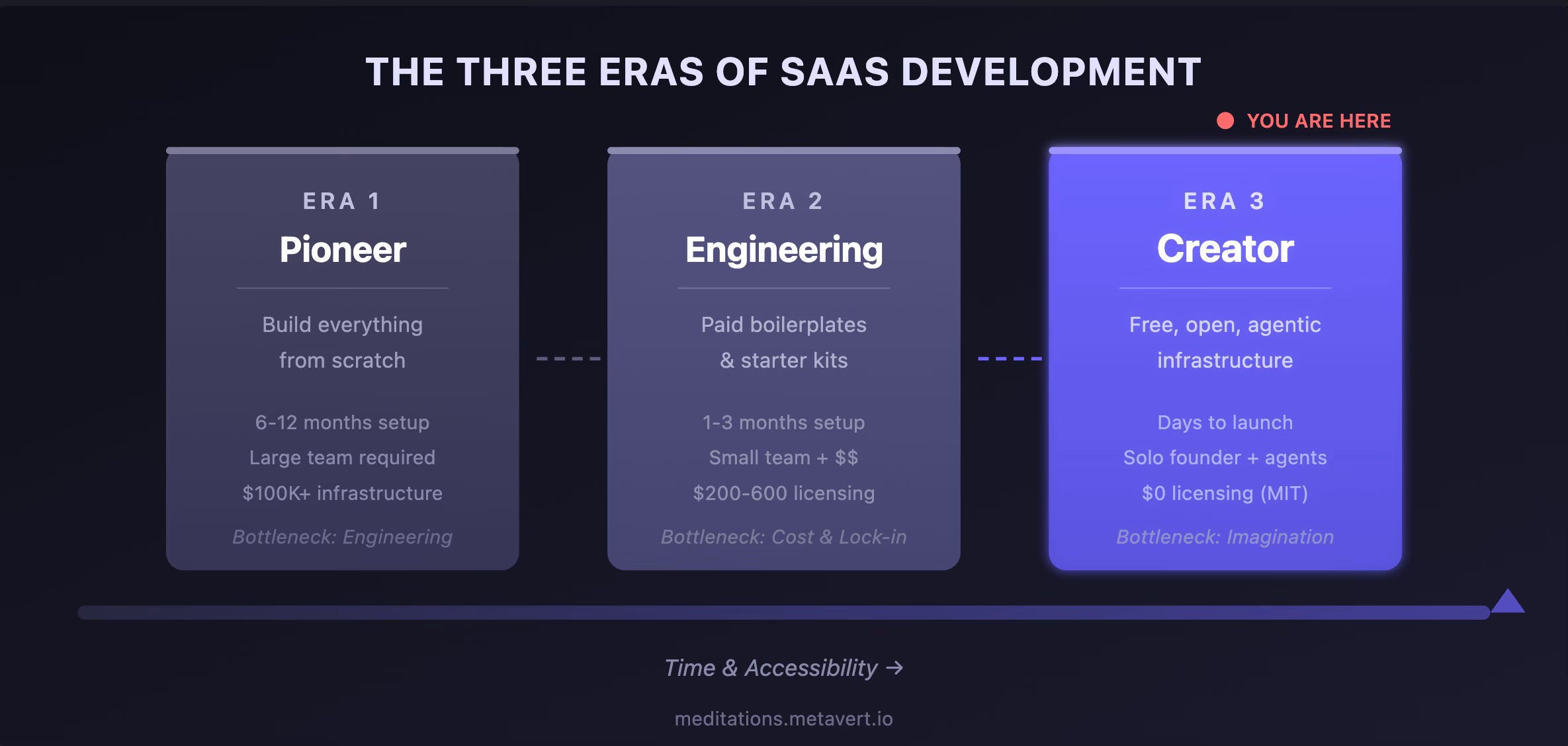
You no longer need a team to launch a SaaS business
Here’s what changed. A solo founder with a clear product vision can now do what once required a ten-person startup. AI coding agents — Claude Code, Cursor, Copilot — handle the engineering. Cloud infrastructure handles the scaling. The only piece that was still missing was the starting point: a production-grade SaaS foundation that doesn’t cost hundreds of dollars, doesn’t lock you into a single JavaScript framework, and doesn’t fall apart the moment you need real multi-tenancy or webhook infrastructure.
The existing market tried to solve this with paid boilerplates: ShipFast ($199), Supastarter ($349–399), MakerKit ($199–599), SaaSRock ($117+), SaaS Pegasus ($249+), Shipped.club ($157), LaunchFast ($99–249). Some are decent. Most cover authentication and Stripe integration. A few support multi-tenancy.
But I evaluated every one of them and kept hitting the same wall. They charge licensing fees for commodity infrastructure. They lock you into specific frameworks (almost always Next.js). Most lack the features a real production SaaS needs: proper webhook systems, white-label capabilities, health monitoring, API key management. And none of them were built for the way software is actually being made right now: through conversations with AI agents, using modern stacks that AI tools navigate fluently.
The constraint for today’s entrepreneur isn’t engineering capability.
It’s imagination…
…knowing what to build and who to serve. LastSaaS eliminates the infrastructure tax so you can focus entirely on that.
What LastSaaS actually is
LastSaaS is a production-grade SaaS foundation built on Go 1.25 and React 19 with TypeScript. I chose this stack deliberately: Go gives you the performance characteristics and deployment simplicity that a backend demands; React 19 with Vite 7 and Tailwind CSS 4 gives you a modern, component-based frontend that AI agents navigate fluently.
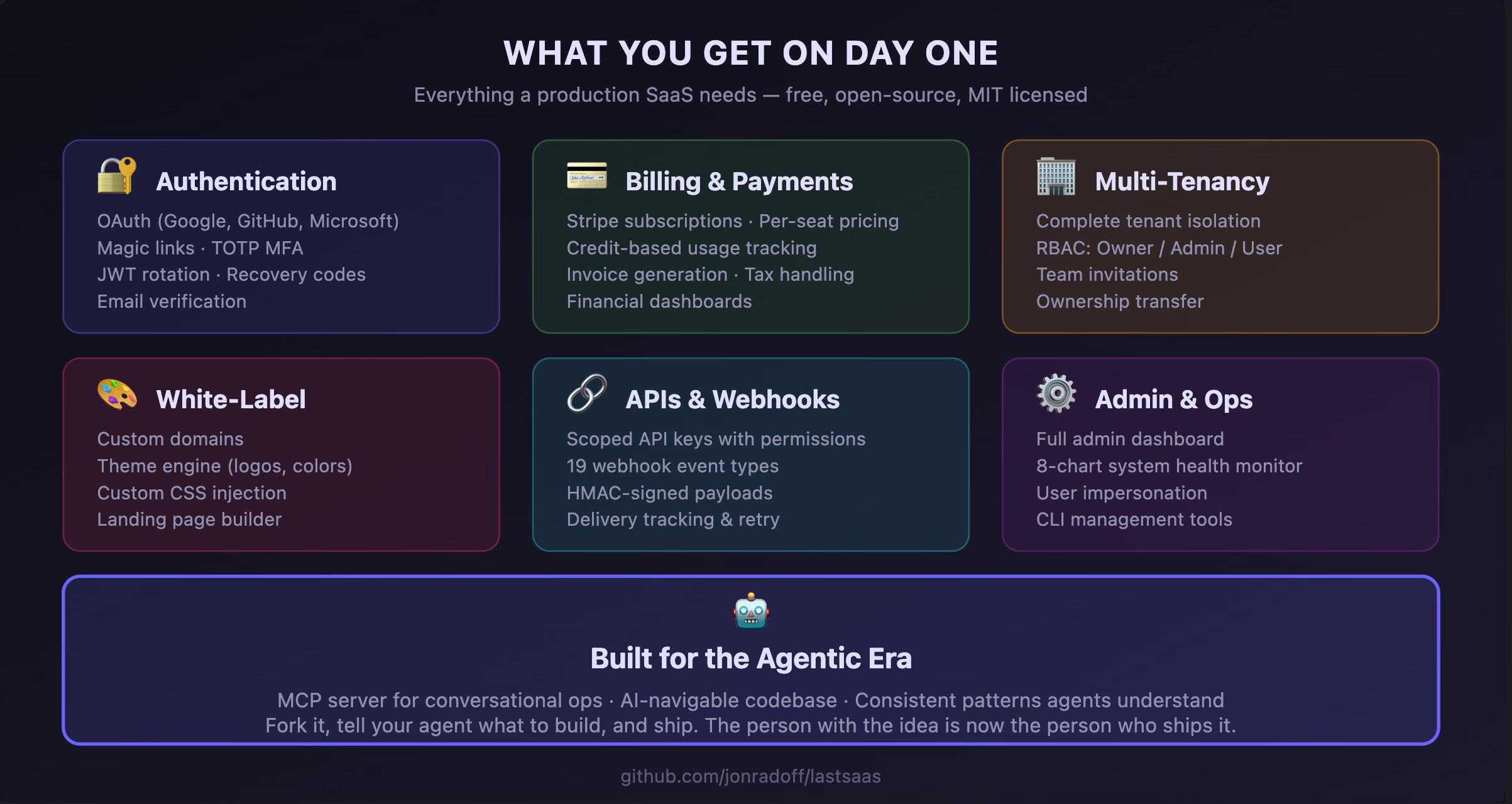
Here’s what you get on day one:
Authentication and identity. OAuth integrations for Google, GitHub, and Microsoft. Magic link passwordless authentication. TOTP multi-factor authentication with recovery codes. JWT token management with refresh rotation. Email verification. This isn’t a toy auth system. It’s the same security infrastructure you’d build if you had six months and a dedicated security team.
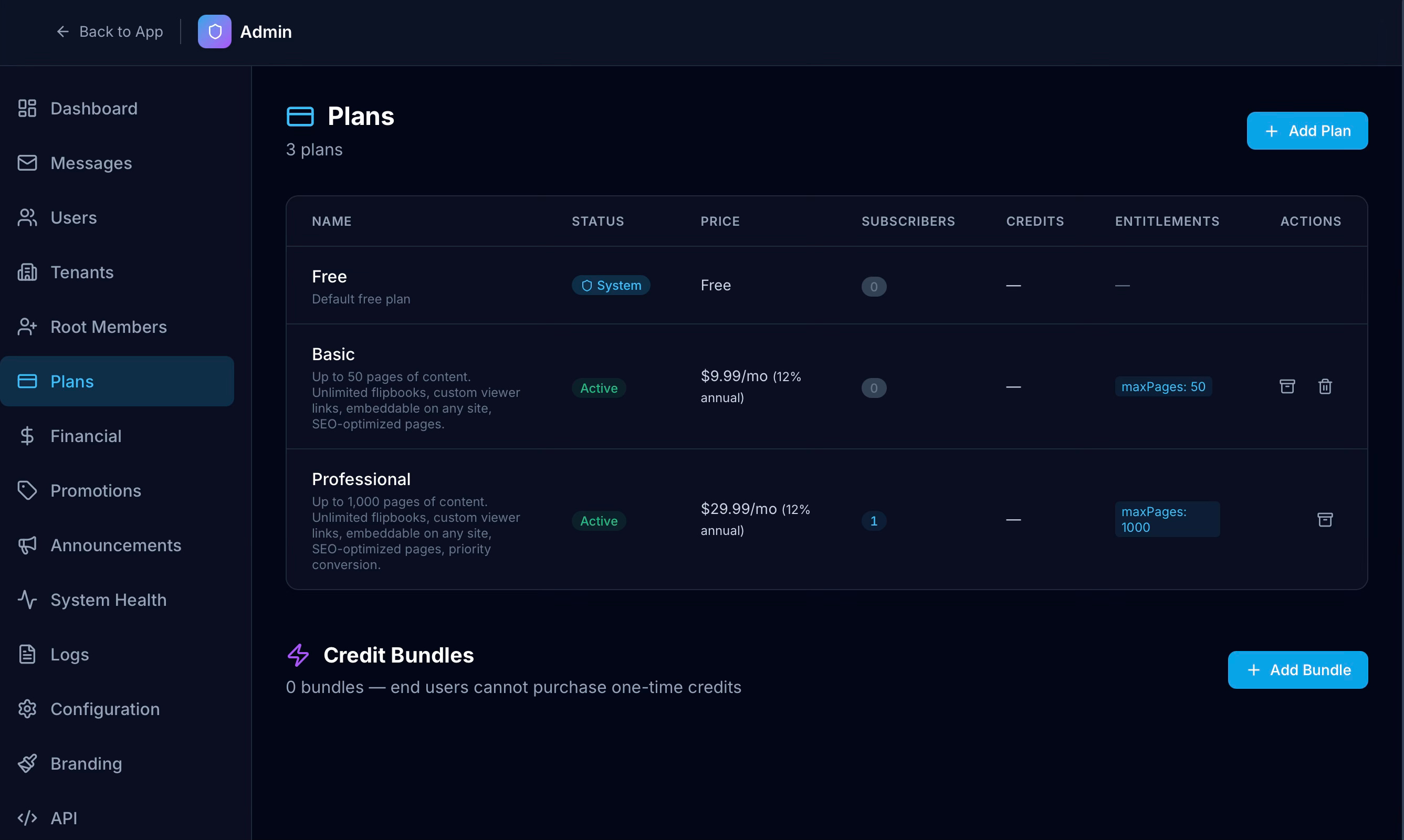
Billing and monetization. Full Stripe integration supporting subscription billing, per-seat pricing models, free trial management, and a credit-based usage tracking system. Invoice generation. Tax handling. Financial dashboards that give you operational visibility from day one. Credit bundle purchases for consumption-based models.
True multi-tenancy. Three-tier role-based access control: owner, admin, user — with tenant isolation. Team management and invitations. Ownership transfer.
White-labeling. Custom domain support. A theme engine for logos, colors, and visual identity. Custom CSS injection. Configurable navigation. Landing page customization. Your customers’ customers never see your brand unless you want them to.
API ecosystem. Scoped API keys with granular permissions. Nineteen outgoing webhook event types with HMAC-signed payloads for security. Webhook management and delivery tracking with retry logic. This is the kind of API infrastructure that separates a real platform from a demo project.
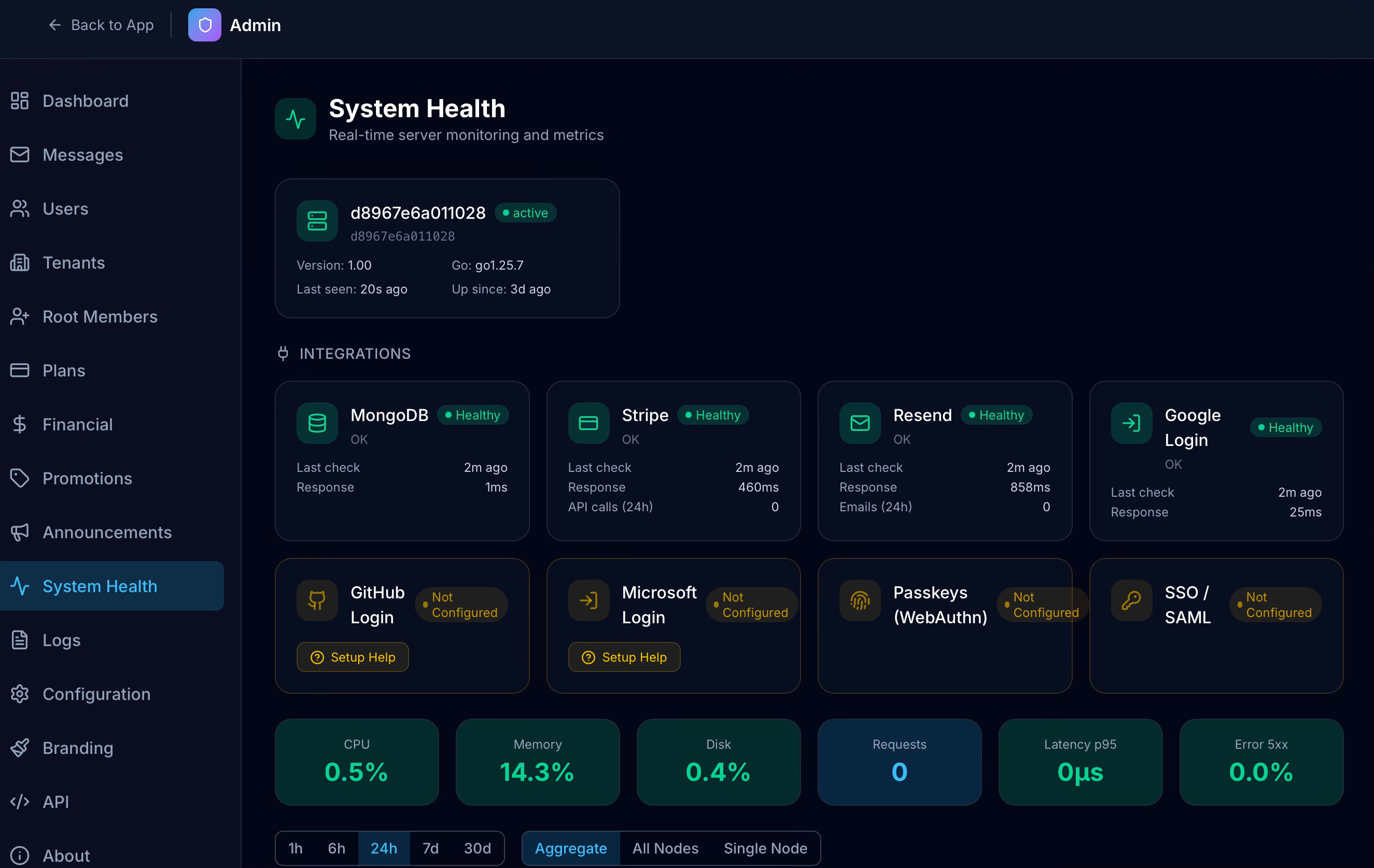
Operations and admin. A comprehensive admin dashboard. System health monitoring with eight visualization charts. User impersonation for support and debugging. CLI utilities for management tasks.
For the technical founders: how it works under the hood
I want to take a moment for the engineers and technical founders reading this, because the architecture decisions matter and they reveal something about the philosophy.
Go on the backend was a deliberate choice. Not Node. Not Python. Go gives you compiled binaries with minimal runtime dependencies, trivial containerization, built-in concurrency through goroutines, and memory efficiency that means your $5/month Fly.io instance can handle real production traffic. The API layer uses gorilla/mux for routing — battle-tested, well-understood, and straightforward for agents to navigate.

React 19 with TypeScript on the frontend because the ecosystem is massive, the type safety catches errors before they ship, and every AI code generation tool on the planet has been trained extensively on React patterns. When you fork LastSaaS and tell Claude Code to add a new dashboard view, it knows exactly what to do.
MongoDB for data because document-oriented storage maps naturally to multi-tenant SaaS architectures. Each tenant’s data is structurally isolated without the complex row-level security policies that multi-tenant PostgreSQL demands. Document schemas flex as your product evolves, which matters enormously in early-stage SaaS where your data model changes weekly. You can run MongoDB Atlas for managed hosting or deploy locally; your choice, no vendor lock-in.
Security isn’t an afterthought. JWT refresh rotation prevents token theft from becoming permanent compromise. HMAC-signed webhooks ensure your integration partners can verify payloads. Content Security Policy headers, HSTS, rate limiting, and injection protection are baked in. TOTP MFA with recovery codes means your users’ accounts are protected by the same second-factor approach used by every serious SaaS.
The codebase follows consistent patterns specifically because AI agents need navigable, predictable code structure. Every handler follows the same shape. Every model follows the same conventions. This isn’t just good engineering practice — it’s an explicit design requirement for the agentic era.
Designed for agentic engineering
I’ve written extensively about the distinction between vibe coding and agentic engineering. Vibe coding is the casual, prompt-and-pray approach: you describe something to an AI and hope the output works. Agentic engineering is the professional practice of orchestrating AI agents within structured systems to produce reliable, production-quality software.
LastSaaS was built through agentic engineering — developed in conversations with Claude Code — and it’s designed to be extended the same way. This isn’t a marketing claim. It’s an architectural decision that permeates the codebase.
Three things make this concrete:
The MCP server. LastSaaS includes a built-in Model Context Protocol server that enables conversational management of your running application. Your AI agents can interact with the SaaS platform through natural language — querying tenant status, analyzing financial reports, monitoring health. This is operational infrastructure for machine societies, not a gimmick.
Fork-ready architecture. The consistent patterns, clear separation of concerns, and predictable code structure mean that when you fork LastSaaS and point an AI coding agent at it, the agent understands the codebase immediately. No onboarding period. No “figure out what the previous developer was thinking.” The code was written by an AI-human collaboration; it’s natively fluent for the next AI-human collaboration.
Scoped API keys. Your agents need programmatic access with least-privilege permissions. LastSaaS provides granular API key scoping so you can give an agent exactly the access it needs and nothing more. This is how responsible agentic systems are built.
The person with the idea can now be the person who ships it. LastSaaS removes the last structural barrier between imagination and a running SaaS business.
The competitive landscape
Let me be direct about how LastSaaS compares to the existing market. I evaluated these alternatives extensively before building this.

ShipFast ($199) is probably the most popular SaaS boilerplate right now, built by Marc Lou on Next.js. It’s well-marketed and covers the basics: auth, Stripe, email, SEO. But it lacks true multi-tenancy, has no webhook system, no white-labeling, and no MCP integration. For a landing page with auth and payments, it works. For a production SaaS platform, it’s insufficient.
Supastarter ($349–399) offers multi-framework support across Next.js, Nuxt, and SvelteKit, which is appealing. It includes multi-tenancy and seat-based billing. But there’s no webhook infrastructure, no white-label capabilities, and the agentic support is limited to Vercel’s AI SDK — useful for building AI features into your product, not for building withAI agents.
MakerKit ($199–599) provides solid auth, Stripe integration, and RBAC on Next.js. The Teams tier adds AI chatbot and writer plugins. But the webhook system is basic, there’s no white-labeling, and the premium features that differentiate it cost $599 — for code you’ll immediately need to modify.
Open SaaS (free) deserves mention as the only other serious free option. Built on the Wasp framework with React and Node.js, it’s gained 10,000+ GitHub stars and includes Claude integration. The limitation: it requires learning the Wasp framework, its multi-tenancy is basic, and it lacks the webhook, white-label, and operational monitoring infrastructure that production SaaS demands.
SaaS Pegasus ($249+) is the strongest competitor for AI-focused development, with built-in LLM agent support. But it’s Django/Python — a fine choice if you’re in that ecosystem, but Go’s performance and deployment characteristics are a generation ahead for API-heavy SaaS backends. And it’s not free.
Shipped.club ($157) and LaunchFast ($99–249) round out the paid market. Both cover authentication and payments on Next.js or multi-framework stacks. Neither offers multi-tenancy, webhooks, white-labeling, or agentic development support. They’re landing-page-to-payment pipelines, not SaaS platforms.
Here’s the pattern: every paid boilerplate charges you $100–600 for commodity infrastructure that’s missing critical production features. The free alternatives cover the basics but lack the depth needed for serious multi-tenant SaaS. LastSaaS delivers more features than any paid competitor—for free—and it’s the only one purpose-built for agentic engineering workflows.
What this represents
I’ve been tracking the evolution of creative industries through three eras: Pioneer, Engineering, Creator—for years. In the Pioneer Era, building a SaaS product required a large engineering team, months of infrastructure work, and significant capital. In the Engineering Era, paid boilerplates and frameworks reduced the timeline but introduced licensing costs and framework lock-in. The constraint shifted from ability to access.
The Creator Era eliminates both constraints. LastSaaS provides the infrastructure layer for free. AI agents provide the engineering capability. The only remaining bottleneck is the idea itself — the vision for what your SaaS product should be and who it should serve.
This is exactly the thesis I laid out in “Software’s Creator Era Has Arrived”—the gap between intention and implementation has collapsed. What used to require a founding team of engineers now requires a founder with clarity of vision and the ability to orchestrate AI agents. LastSaaS is the infrastructure layer that makes this real.
I built Flipbook, a live production SaaS—on this foundation (you can also just install Flipbook on your own machine and use it without SaaS, but I wanted to use it as a live production example). It works. It’s handling real users, real payments, real multi-tenant workloads. LastSaaS isn’t a proof of concept. It’s production infrastructure that’s already proven.
Get started
LastSaaS is live on GitHub under the MIT license. Clone it. Fork it. Tell your AI agent to customize it for your domain. Ship your SaaS.
🔗 GitHub: github.com/jonradoff/lastsaas
🔗 Learn more: metavert.io/lastsaas
The setup is straightforward: clone the repo, run the setup script, configure your environment variables for MongoDB, Stripe, and Resend, and you have a running SaaS platform. The README walks through every step. Docker containerization and Fly.io deployment are documented and tested.
The person with the idea can now be the person who ships it. The infrastructure is free. The agents are ready. The only question is what you’ll build.
Further reading
Software’s Creator Era Has Arrived: The case for why the bottleneck in software has shifted from engineering to imagination, and what that means for who gets to build.
Semantic Programming and Software: Natural language as a programming language. The conceptual foundation for why agentic engineering works.
The Direct-from-Imagination Era Has Begun: The original essay on how creative tools evolve through Pioneer, Engineering, and Creator eras — and why software is following the same path.
Evolution of the Creator Economy: Where LastSaaS fits in the larger arc of how technology democratizes creative industries.
Having built something the old way, I can’t wait to try this! Extraordinarily impressive.